My blog has moved!

You should be automatically redirected in 6 seconds. If not, visit
http://catholicfamilyvignettes.wordpress.com
and update your bookmarks.

Showing posts with label tridentine. Show all posts

Monday, July 16, 2007

A Low Mass...

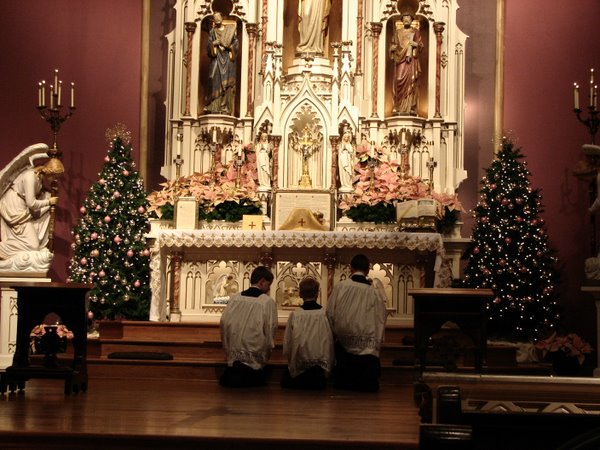
One priest, chasuble emblazoned with the image of Our Lady. Four seminarians in cassock, surplice and biretta. Four young brothers, all vested, sitting in choir. Four young men, in the congregation, prepared to serve if needed.

This was a Low Mass! An announcement was made Sunday, that a Latin Mass would be offered at 9:00 a.m., for the Feast of Our Lady of Mount Carmel. Short notice, but met with enthusiasm by those willing and able to attend. Attendance was light with perhaps 20 or so adults, but there were no less than twenty-five children present.


After Mass, several moms congregated on the steps outside, with the children playing all around. Cheerful greetings exchanged, plans to meet at the park, old friends welcomed back...peace, joy and fellowship. The fruits of this simple, Low Mass!
Read more!

Thursday, July 12, 2007

Searching for the extraordinary...

From Lumen Gentleman:

Summorum Pontificum Contact Database

Search for contacts in your area

The motu proprio has been released! The next step is to start putting the Catholic faithful who want to assist at the extraordinary form of the Holy Mass in touch with Catholic priests who want to say the extraordinary form of the Holy Mass.


An online form is available to facilitate the search of the faithful seeking access to the Traditional or Extraordinary Form of the Holy Sacrifice of the Mass. A database "search" feature will also provide contact information for specific parishes.

A tip of the hat (once again) to Rorate Caeli for this quote from Thomas Woods:

"For several decades, not only the Catholic left but also the 'orthodox' Catholic right condemned supporters of the 1962 Missal as disobedient, wicked, schismatic – you name it – because they believed that what was beautiful and venerable yesterday could not cease to be beautiful and venerable today. They likewise found it hard to believe that they were considered a little bit crazy, perhaps even in need of counseling, because they longed for the traditional Mass, the very thing they had been taught their whole lives to venerate."

The entire text of Mr. Woods article may be obtained here.
Read more!

Monday, July 2, 2007

And then the Caveman said...

What the Caveman has to say:

With regard to the suppression [of the Traditional Latin Mass in 1969], this individual wrote: "A community is calling its very being into question when it suddenly declares that what was its holiest and highest possession is strictly forbidden and when it makes the longing for it seem downright indecent."

Now THAT'S powerful! "Calling our very being into question... makes the longing for it seem downright indecent." Want to guess who said that? I'll tell ya... Joseph Cardinal Ratzinger in his interview-book Salt of the Earth (1997). Gee, I've been saying that for years. Looks like I'm in good company, eh?

But for those who still buy into the myth that "the spirit of V2" is getting us back to our roots, allow me to point the following out to you;

The Latin Mass isn't something that magically appeared back in the 1500's during the Council of Trent. Neither did it simply fall from the sky when Pope St. Gregory the Great introduced The Gregorian Sacramentary in the 6th century. Even the Canon of the Latin Mass dates to the 4th century. The historical fact of the matter is, even in it's infancy, the Latin Mass has been with us since the 1st century when Sts. Peter and Paul first preached in Rome. The words of the Consecration have remained constant for 2,000 years within the Latin Mass. There simply is no getting around that.

Oh, before I forget... why did Pope St. Gregory the Great even want to retain Latin in the liturgy? Golly, could it be because he realized that Latin was unchanging, and that this new language called Italian was ever evolving and constantly changing? Yep... that exactly the reason. Boy, they didn't call him "The Great" for nothing, huh? I'd wager if he were around today, many would call him a Rad-Trad or possibly even a caveman.

Anyhow, So for all those nay-sayers who have all the theological, ecclesiastical and historical depth of a kiddie wading pool, please refrain for the soft-headed notion that the Motu Proprio is all about the SSPX, or simply pleasing (shutting up) a extremely small number of "Rad-Trads".

It's all about our very being of being Catholics. If you have any questions, direct them to the guy who lives in Rome who wears those really cool Prada shoes..
Read more!

Thursday, June 28, 2007

Laus Deo!!


From Rorate Caeli:

OFFICIAL COMMUNIQUÉ OF THE HOLY SEE PRESS OFFICE

"A meeting took place yesterday afternoon at the Vatican, presided by the Cardinal Secretary of State, in which the content and the spirit of the expected "Motu proprio" of the Holy Father on the use of the Missal promulgated by John XXIII in 1962 were explained to the representatives of several episcopal conferences. The Holy Father came to salute those who were present and maintained a deep discussion with them for about one hour. The publication of the document - which will be accompanied by a thorough personal letter of the Holy Father to the singular Bishops - is predicted for within a few days, when the document itself will be sent to all Bishops with the indication of its successive coming into effect."

Let us praise God!

Te Deum

Te Deum laudamus: te Dominum confitemur.
Te aeternum Patrem omnis terra veneratur.
Tibi omnes Angeli; tibi caeli et universae Potestates;
Tibi Cherubim et Seraphim incessabili voce proclamant:
Sanctus, Sanctus, Sanctus, Dominus Deus Sabaoth.
Pleni sunt caeli et terra maiestatis gloriae tuae.
Te gloriosus Apostolorum chorus,
Te Prophetarum laudabilis numerus,
Te Martyrum candidatus laudat exercitus.
Te per orbem terrarum sancta confitetur Ecclesia,
Patrem immensae maiestatis:
Venerandum tuum verum et unicum Filium;
Sanctum quoque Paraclitum Spiritum.
Tu Rex gloriae, Christe.
Tu Patris sempiternus es Filius.
Tu ad liberandum suscepturus hominem, non horruisti Virginis uterum.
Tu, devicto mortis aculeo, aperuisti credentibus regna caelorum.
Tu ad dexteram Dei sedes, in gloria Patris.
Iudex crederis esse venturus.
Te ergo quaesumus, tuis famulis subveni: quos pretioso sanguine redemisti.
Aeterna fac cum sanctis tuis in gloria numerari.

V. Salvum fac populum tuum, Domine, et benedic hereditati tuae.
R. Et rege eos, et extolle illos usque in aeternum.

V. Per singulos dies benedicimus te.
R. Et laudamus nomen tuum in saeculum, et in saeculum saeculi.

V. Dignare, Domine, die isto sine peccato nos custodire.
R. Miserere nostri, Domine, miserere nostri.

V. Fiat misericordia tua, Domine, super nos, quemadmodum speravimus in te.
R. In te, Domine, speravi: non confundar in aeternum.
Read more!

Wednesday, June 27, 2007

Motu Proprio!!


The motu proprio liberating the Tridentine Mass for the entire Catholic Church has been given to about 30 bishops from all over the world in the Sala Bologna of the Apostolic Palace by Vatican Secretary of State Tarcisio Cardinal Bertone

Vatican (kath.net/DieWelt/closedcafeteria.blogspot)
Die Welt report that the motu proprio liberating the Tridentine Mass for the entire Catholic Church has been given to about 30 bishops from all over the world in the Sala Bologna of the Apostolic Palace by Vatican Secretary of State Tarcisio Cardinal Bertone.

The bishops had been invited to Rome for that purpose. At the end of the meeting, in which the motu proprio was introduced together with a letter of explanation by Pope Benedict XVI., Pope Benedict met with the bishops. The document is about three pages long, the accompanying letter about four. From Germany, Cardinal Lehmann had been invited. The circumstances of the procedure make clear that the Pope was very interested to personally inform the bishops, in collegial manner, of the content rather than from the media. The publication of both documents will take place on July 7th. It emphasizes the unity of the Roman Rite which will consist of an ordinary and an extraordinary form which are supposed to inspire each other. The ordinary/regular form will continue to be the new rite of 1969. The extraordinary form will be the Missal of Bl. John XXIII. of 1962.
Read more!

Monday, June 18, 2007

From U.S. News and World Report:

A Return to the Latin Mass
Clashes with congregants may erupt as a growing number of young priests push for a revival of pre-Vatican II customs
By Eric Ferkenhoff
Posted 6/17/07

Nearly two generations of Catholics now have grown up in a post-Vatican II world, worshipping in a church that celebrates mass in their local languages and, at least to some extent, embraces modern customs as much as it once rejected them.

So it seemed anathema when the Vatican confirmed recently that Pope Benedict XVI would relax restrictions on celebrating the 16th-century Tridentine Mass, citing "a new and renewed" interest in the ancient Latin liturgy, especially among younger Catholics.

Given the fierce fight that preceded Vatican II—the liturgical and doctrinal reforms of the mid-1960s that sought to make the church more accessible—a similar war would seem needed to overturn them. But a movement is building at seminaries nationwide to do just that: In addition to restoring the Latin mass, young priests are calling for greater devotion to the Virgin Mary, more frequent praying of the rosary, and priests turning away from the congregation as they once did. Perhaps most controversially, they also advocate a diminished role for women, who since Vatican II have been allowed to participate in the mass as lay altar servers and readers.

Such changes would seem to aggravate the church's growing attendance problems(in 2003, 40 percent of Roman Catholics said they had attended church in the past week, down from 74 percent in 1958) as well as enhance its air of exclusivity—the notion of Catholicism as the only true faith. Yet proponents of the movement argue that just the opposite holds: More people will attend mass if the traditions are richer and the doctrine stricter. The Latin mass, they say, would restore a sense of community they believe was diluted when the church allowed local culture to override tradition. In Chicago alone, mass is now said in some 50 languages.

"The traditional Latin mass simply excels at conveying the majesty and mystery of God," says Michael Dunnigan, a canon lawyer and chairman of the pro-Latin mass group, Una Voce America. Rejecting comparisons to fundamentalism, he denies that proponents are simply seeking more structure and discipline. "At the heart of the movement is a longing for beauty and an attitude of profound reverence," he says. Andrew Vogel, a seminarian from Rochester, Minn., notes that before Vatican II, mass attendance was at its highest and seminaries were full. "People just think we must have been doing something right," he says.

In today's Catholic churches, priests are free to celebrate a contemporary Latin mass, but they cannot celebrate the Latin mass as it was structured before 1962 without permission of their bishop. It is this restriction that the pope is considering lifting.

The proponents of the old Latin mass are said to number no more than 2 percent of Catholics, and polls show that the majority of Catholics embrace the reforms of Vatican II. But the Latin movement may be strong enough to carve a divide. Thomas Reese, a fellow at the Woodstock Theological Center at Georgetown University predicts "a clash of cultures between clergy and the more liberal congregations as more of these conservative priests graduate and make their presence known."

He predicts that other old practices will be restored as the Vatican tries to impose the conservative values of Benedict on a more liberal world. "This is so much more about politics than it is about Latin and liturgy," Reese says.

According to published reports, the pope was, among other things, trying to bridge a divide with the traditionalist Society of St. Pius X, even though that group has expressed concern about reversing the gains of Vatican II.

The Latin movement also has its detractors outside the faith. Jewish leaders take offense with older rites' references to Jews as faithless, and they worry that a revival of the old traditions could foster anti-Semitism.

But such arguments seemed far from the minds of the 20-odd worshipers who gathered last Friday for the Latin mass at Chicago's St. John Cantius Church. "You put the old rite and the new side by side, and there really is no comparison," says Simon Varnas, 35. "The old rite is far superior. It is more conducive to prayer, recollection, and personal dedication."

This story appears in the June 25, 2007 print edition of U.S. News & World Report.
Read more!