My blog has moved!

You should be automatically redirected in 6 seconds. If not, visit
http://catholicfamilyvignettes.wordpress.com
and update your bookmarks.

Thursday, August 9, 2007

Tutorial on the Tridentine


Tip o' the hat to seminarian Matthew at A Catholic Life for this link: Sancta Missa. If you know a priest who is unfamiliar with the Extraordinary Form of the Mass or if you are simply curious about the rubrics of this beautiful rite, visit Sancta Missa.

There is wealth of information available, beautifully and faithfully presented. Additional links and information are coming soon, but the tutorial alone is worth a look!

For those of you who have not yet had the privilege of attending the Traditional Mass, Una Voce America can provide additional resources, as well as assist you in locating a Traditional Mass near you.

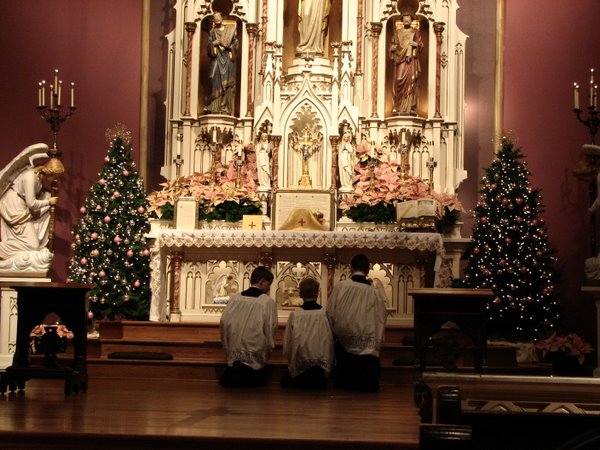
The impact the Traditional Mass has had upon our family is simply astounding. We have been attending this Mass for a little over two years and every member of the family spends the entire week in anticipation of the Sunday Feast.

We have been changed by beauty and reverence...it has filtered into every aspect of our daily life. Our life is the Mass.

Deo Gratias!


Read more!

Wednesday, August 8, 2007

The Tears of St. Lawrence - August 11th-13th


Have you ever watched the Perseid Meteor Shower? What an incredible light show! The event has also been called, from antiquity, The Tears of St. Lawrence.

St. Lawrence, also called Laurentius, a Christian deacon, is said to have been "martyred by the Romans in 258 AD on an iron outdoor stove. It was in the midst of this torture that Laurentius cried out: "I am already roasted on one side and, if thou wouldst have me well cooked, it is time to turn me on the other."

The saint's death was commemorated on his feast day, Aug. 10. King Phillip II of Spain built his monastery place the "Escorial," on the plan of the holy gridiron. And the abundance of shooting stars seen annually between approximately Aug. 8 and 14 have come to be known as St. Lawrence's "fiery tears."

The best possible tip for viewing: travel outside the city. "Light pollution" greatly reduces visibility as do the many structures that obscure the night sky.

Check your city and county parks departments. Many offer "night sky viewings" organized by local college astronomy departments and park personnel.

Finally, PRAY for a clear sky! Cloud cover will make the viewing impossible.

So, grab a blanket and gaze at the night sky with your loved ones. The "ooohs" and "aaahs" will rival those of the 4th of July fireworks display.

Read more!

Tuesday, August 7, 2007

"Have mercy upon me, O God, after thy great goodness."

A respite in the midst of the everyday...


I realize it is not yet Lent...but this piece is so very beautiful...
Read more!

Monday, August 6, 2007

Are these pumpkins...or tomatoes?


Tomatoes! Absolutely huge, juicy, yellow and red striped, tomatoes. Meet Mr. Stripey! Big as these two are, I picked a much larger one today...

These lovely tomatoes are so delicious, with a mild, non-acidic flavor, meaty and nearly seedless texture. The majority of our tomato production will be stored as sauce, but Mr. Stripey...strictly for eating fresh! The German Queen tomatoes are in full swing as well, and the sheer size of these "ladies" is astounding.

Fresh, sliced tomatoes...this is what summer tastes like...
Read more!

Irish Festival!


Ah, the Irish Festival in Dublin, Ohio. The food, the drink, the music...the chance to sit in a "currach" like St. Brendan, pick up a sword, club and shield and fight next to a priest. Don't let the "dress" fool you. Joseph says Fr. Hayes is a mighty warrior!

Temperatures in the 90's didn't seem to prevent the crowds from attending. The boys brought home a couple loves of Irish bread and tales of fierce battle...

Ah, me little warriors...
Read more!

Sunday, August 5, 2007

Learning to fly...


Call them the "Young Eagles" or even the "Rocket Boys". This past summer has been "high" adventure for my guys...from a free flying lesson through the Young Eagle program, to the dynamics of backyard rocketry.

The boys have traveled to Toledo (OH), Lancaster (OH) and Muncie (IN) and have met a variety of enthusiasts of all ages.

They are now fully armed with their "Young Eagle" certificates, rockets in all shapes and sizes, RC planes and helicopters and not a few balsa wood models to construct. Looks like this year's science program will be rounded out with the "principles of aviation and aeronautical design and propulsion."

The slideshow is available by clicking the "read more" link. Thanks to Tom Ryan and my dear husband for the incredible photos. The air shots were all taken by Mr. Ryan. Thank you, gentlemen, for a summer full of science and excitement!


Read more!

Saturday, August 4, 2007

Christ In The House Of His Parents - John Everett Millais 1850

I'm not sure how many of you have examined the banner image that introduces this blog. It is a Pre-Raphaelite work by John Everett Millais titled Christ in the House of His Parents. This particular painting is very dear to me. The rich imagery and symbolic realism invite the viewer to a deeper contemplation of the events unfolding.

I am certainly no critic, nor am I particular well-versed in explaining "typology." Here is an excerpt from an excellent essay by Professor George P. Landow, Brown University, which provides an outstanding explanation of the various aspects of this painting as it pre-figures our Lord's Passion and Resurrection:

Millais's Christ in the House of His Parents (1850) and Hunt's The Finding of the Saviour in the Temple (1854-60) exemplify the early Pre-Raphaelite use of typology as a basis for symbolic realism. Millais, who was inspired by a High Anglican sermon in Oxford to paint his picture, provides an instance of Tractarian use of such symbolism, for his representation of an imagined event from the life of Jesus serves as an image of Christ as priest and sacrifice. The painter has represented the boy Christ immediately after He has wounded Himself trying to remove a nail from a board with pincers, and this event, like the cornerstone in Tintoretto's Annunciation, turns the coarse details of genre painting into spiritual fact. Jesus, whom Mary comforts, holds up His hand so that both Joseph and the spectator can see His wound. The blood on His wounded palm and that which has dropped upon His foot presents a prefigurative image of both the Crucifixion and the resurrected Christ presenting Himself to the eye of faith in the form of the Man of Sorrows. (Compare, for instance, Albrecht DĂŒrer's Man of Sorrows with Hands Raised [c. 1500], an engraving upon which Hunt may have drawn in designing The Shadow of Death. According to him, he and his friends studies such earlier engravings in the British Museum Print Room, and so he and Millais would have encountered various versions of this subject.) Many of the details in Christ in the House of His Parents also prefigure the passion and death of Christ and thus reinforce the meaning of the picture's central image. The pincers and nail toward which Anne extends her hand are emblems of the Crucifixion, and the carpenter's tools and ladder on the wall behind Jesus also remind us of this event. Similarly, John's coming to Christ with a bowl of water probably serves as loose types of Christ's baptism and also of the vinegar and gall offered to Him when He was dying on the Cross. It is even possible that it could allude to the water and blood which poured forth from Christ's side when pierced by a spear — but here the possibility seems rather distant indeed. The partially woven basket on the painting's extreme left suggests both that the total scheme of Christ's atonement is not yet complete and that these reeds prefigure those mockingly thrust on Christ as King of the Jews. The bird perched on the ladder symbolizes the Holy Ghost, the sheep outside all human beings, and the workbench the communion table.

Whereas one set of types and symbols prefigures this imagined event's significance as a type of the passion and death of Jesus, another makes the specifically High Church interpretation of them in terms of an ordained priesthood. (Alastair Grieve suggests Tractarian readings of this painting in "The Pre-Raphaelite Brotherhood and the Anglican High Church," Burlington Magazine 111 (1969): 294-95; see also G. B. Tennyson's, "Tractarian Aesthetics," Victorian Newsletter 55 (1979): 8-10.). The Tractarian notion of "reserve," which is based on the belief that sacred truths must be protected from profanation by the uninitiated, finds one of its embodiments in this party's emphasis upon devices separating laity and priesthood." Tractarian reserve, which colors High Church sermons, devotional poetry, and church design, here takes the visual form of a composition that separates the sacred interior inhabited by the Holy Family from that exterior space containing the sheep. Drawing upon older Northern Renaissance compositional schemes which derive from depicting the Virgin and child against a Cloth of Honour, Millais sets this event from the childhood of Jesus against a central panel surrounded by two openings into the distance. He then sets his image of the wounded Jesus close to the picture plane against the picture's central panel. Like Hunt's The Finding of the Saviour in the Temple, Millais's painting partially surrounds the young Jesus by a group of symbolic figures, and although Mary stands closest to her son in both pictures, she takes on a different meaning in each. In Christ in the House of His Parents, Mary joins her son as an object of veneration, for her sorrow at the young boy's wound prefigures greater sorrow in the same way that the wound serves as a type of the Crucifixion. In fact, Mary, who does not even embrace her son, appears to adopt a prayerful, reverent attitude as if she understands the full significance of this apparently everyday event -- as she does in similar matters in James Collinson's "The Child Jesus. A Record Typical of the Five Sorrowful Mysteries" (1849-50), an almost exactly contemporaneous poem written by another member of the Brotherhood. [Follow for a detailed discussion.] If Mary's attitude or pose is thus taken as one of sorrowful prayer, it may also be understood to prefigure her conduct at the foot of the Cross. In contrast, Hunt's portrayal of Mary and her son makes it clear that, however well-intentioned a mother she is, she takes her place with those in the temple who do not understand her son's message or significance.

Whereas Christ in the House of His Parents makes Tractarian emphases upon separation of priest and laity and upon the high spiritual status of Mary, Hunt's The Finding of the Saviour in the Temple, which obviously does not support Mariolatry, presents an Evangelical rendering of scriptural events. First of all, like the Evangelical preacher who emphasizes the importance of meditating upon the Bible's literal meaning or narrative, Hunt devotes much more personal energy and pictorial emphasis than does Millais to elaborate archeological reconstructions of dress, custom, architecture, and facial type. Moreover, because Hunt accepts that the literal significance of a biblical event includes the mental experiences of those who participate in it, he includes an entire gallery of psychological portraits, and these also serve to prefigure the ways in which men continue to resist Christ's message. In William Holman Hunt and His Works: A Memoir of the Artist's Life, With Description of His Pictures (London, 1860), which the painter's friend F. G. Stephens wrote at the request of Gambart, the art dealer, several pages are devoted to explaining Hunt's elaborately detailed psychological portraits (63-70). As I have argued elsewhere, one can assume that Stephens followed Hunt's explicit interpretations of his own work.

Whereas Millais relies upon an assemblage of types within Christ's life to prefigure the Saviour's death and passion, Hunt uses a similar gathering of images to present a more original interpretation of the person and message of Christ. In presenting that moment when Christ suddenly recognizes who He is — and that He has come to fulfill type and prophecy — he presents a specifically Evangelical interpretation of older pictorial themes. Like most Evangelicals, Hunt markedly deemphasizes the role and importance of Mary, and so The Finding of the Saviour in the Temple, which presents what is essentially Christ's "conversion," provides an image of God's appearance in history. In other words, in a characteristically daring manner Hunt reinterprets the traditional theme of the dispute with the doctors and thus produces an Evangelical analogue to the Annunciation to Mary. Furthermore, Hunt's painting not only in this way reshapes and reapplies an older pictorial convention, but it also emphasizes another Evangelical doctrine, the importance of preaching the Gospel, for Christ is shown in the midst of reinterpreting the Law when His parents arrive.

Like Northern Renaissance images of the Annunciation or Adoration which use types to transform these earthly scenes into emblems of the Eternal Mass in Heaven, Hunt employs a wide range of types to turn this historical moment into a privileged instant during which the temporal and eternal coincide [See Lotte Philip, The Ghent Altarpiece and the Art of Jan van Eyck (Princeton, 1971), 56-7, 61-4; and Shirley Neilsen Blum, Early Netherlandish Triptychs: A Study in Patronage (Berkeley, 1969). Landow, William Holman Hunt, 101-2, 129, 131, explains this Victorian's attempt to find equivalents to older applications of this form of symbolism.]. As one who placed little emphasis upon the sacraments, Holman Hunt was unable to devote himself, like Millais, to types which could create images of the Mass in this traditional manner, and so he dedicated much of his efforts in religious painting to finding modern equivalents for older themes. None the less, he still employs typology, much as had Van Eyck and Memling, to surround a central image with scriptural symbols that serve to place it in a privileged, sacred time and space. For example, in The Finding, which combines Evangelical emphases upon preaching and conversion, Hunt includes types that comment upon the central encounter. Thus, the cornerstone originally rejected by the builders appears in the courtyard at the right side of the painting, and one is meant to perceive that the completion of the old dispensation which takes place in physical form outside the temple is also taking place in spiritual form within. Similarly, just as someone tries to drive out a dove, which represents the Holy Ghost, the Rabbis are trying to drive out Christ's new spiritualization of the Law. The blind beggar outside the door advances the picture's meaning in two ways: first, he serves as an emblem of the blind ignorance within and, second, he is a type of the blind given sight by Christ. The lamb brought to slaughter over the objections of its mother offers another double significance: it parallels the relation of Christ and Mary and it shows Christ, the true sacrifice, coming to complete and abrogate the Levitical law. Even the cross on Christ's belt, which had been an ornamental design since ancient times, becomes endowed with new significance in this context.

Typology, which has the intrinsic capacity to bridge pictorial realism and complex iconography, also serves to endow the scene represented with imaginative grandeur. Both Millais and Hunt produce realistically conceived representations of events from Christ's youth. Although only Hunt's subject receives the sanction of scripture, both use types to make the events they depict seem central moments in human history. Furthermore, both Christ in the House of His Parents and The Finding of the Saviour in the Temple use typological images to set their major actions in several temporal contexts. Millais's painting of the young Christ thus participates in several times: in that of the tormenting and Crucifixion of Jesus, His resurrection, and His presence in the sacrament of the Eucharist. Hunt's painting, which, unlike that of his friend, employs traditional Old Testament types, similarly participates in several times, since the images of lamb, cornerstone, and blind man set these events unfolding before our eyes within the context of Christ's later ministry and death as well as within that provided by the Church's later preaching of the Gospel. Furthermore, Hunt, who often tends to conceive himself as an artistic Messiah, also probably intends his image of Christ's discovery of His nature to apply to the self-recognitions of all those who would bring new truths to unwilling listeners.
Read more!

Darby Creek, Revisited


Red, white and blue dragonflies. Crawdads and frogs. Sunlight glinting upon the ripples of the rushing creek. And a couple of "intrepid" snake hunters!

The temperature was 94 degrees and the coolness of the woods and creek beckoned! A joyful day, as we had the creek entirely to ourselves for nearly 3 hours. A couple of families came down, briefly surveyed the water, admonished their children not to get wet and left.

So sad. They look, but they never explore...and what a place to explore!


We returned home around 3:00 p.m., having missed lunch, and quickly assembled egg salad sandwiches which we ate in the air-conditioned living room, while watching (crikeys!) the Crocodile Hunter on VHS.

Yeah...Steve-o...God rest his soul...

It seemed the perfect way to end the day, particularly after the two boys did their best to provoke a snake...
Read more!

The Feast of St. John Vianney


Here are a few sermons from the St. John Vianney, in honor of his Feast Day. A powerful preacher, our blessed saint fearlessly proclaims the gospel and with great charity instructs the faithful.

THE GIFT OF EVERY DAY

Before beginning your work, my dear brethren, never fail to make the Sign of the Cross. Do not imitate those people without religion who dare not do this because they are in company. Offer quite simply all your difficulties to God and renew from time to time this offering, for by that means you will have the happiness of drawing down the blessing of Heaven on yourself and on all you do. Just think, my dear brethren, how many acts of virtue you can practice by behaving in this way, without making any change in what you are actually doing. If you work with the object of pleasing God and obeying His Commandments, which order you to earn your bread by the sweat of your brow, that is an act of obedience. If you want to expiate your sins, you are making an act of penance. If you want to obtain some grace for yourself or for others, it is an act of hope and of charity. Oh, how we could merit Heaven every day, my dear brethren, by doing just our ordinary duties, but by doing them for God and the salvation of our souls! Who stops you, when you hear the chimes striking, from thinking on the shortness of time and of saying in your minds: "Time passes and death comes closer.

I am hastening towards eternity. Am I really ready to appear before the tribunal of God? Am I not in a state of sin?"

THE PUBLIC CROSSES

I am going to talk to you now about the public crosses, and I am going to give you the reason for their number, for the blessings which flow from them, and for the great honour which the Church pays them. If our interior crosses are so numerous and if the public crosses, these images of that Cross on which our God died, are also so numerous, it is that we may have always present in our thoughts the reminder that we are the children of a crucified God.

We need not be surprised, my dear brethren, at the honour which the Church pays to this holy wood, which obtains for us so many graces and so many benefits. We see that the Church makes the Sign of the Cross in all her ceremonies, in the administration of all the Sacraments. Why is that? My friends, this is why. It is because all our prayers and all the Sacraments draw from the Cross their power and their virtue. During the Holy Sacrifice of the Mass, which is the greatest, the most solemn and the most sublime of all those actions which can glorify God, the priest makes the Sign of the Cross over and over again. God desires that we may never lose the memory of it as the surest means of our salvation and the most formidable instrument for repelling the Devil. He has created us in the form of a cross so that every man might be the image of this cross upon which Jesus Christ died to save us. See how eager the Church is to increase their number? She urges them as a special embellishment on our churches and on all altars; she places them in the most public places.


THE DUTIES OF THE MOTHER

You should never have your children sleeping with you from the time they are two years old. If you do, you are committing a sin. The Church did not make this law without reason. You are bound to observe it.

But, you will say to me, sometimes it is very cold or we are very tired.

All that, my dear brethren, is not a reason which could excuse you in the eyes of God. Besides, when you married, you knew quite well that you would be obliged to fulfil certain responsibilities and obligations which are attached to the married state.

Still, my dear brethren, there are fathers and mothers who are so little instructed in their religion or who are so indifferent to their duties that they will have sleeping with them children from fifteen to eighteen years of age, and often brothers and sisters together. Dear Lord! These poor fathers and mothers are in a terrible state of ignorance! But, you will say, we have no bed.

You have no bed? But it would be better to let them sleep on a chair or in a neighbour's house. Dear Lord! The parents and children who damn themselves! But I will return to my subject and repeat to you that all the time that you allow your children to sleep with you after they have reached two years of age, you are offending God. How many mothers are there who have found their children smothered in the morning! How many mothers are present to whom this calamity has happened! And even if the good God has preserved you from it, you are no less guilty than if, every time your children slept with you, you found them smothered in the morning. You do not wish to agree with this, that is to say, you do not wish to correct it. We will wait until the Judgment, and you will be obliged to recognise what you do not wish to recognise today.

There are mothers who have so little religion or, if you like, are so ignorant that if they want to show off their baby to some neighbouring mothers, they will show it to them naked. Others, when they are putting on diapers, will leave the babies, for a long period of time, uncovered before everyone. Now even if there is no one present at all, you should not do this. Should you not respect the presence of their Guardian Angels? It is the same thing when you are feeding them. Should any Christian mother allow her breasts to remain exposed? And even if they are covered, should she not turn aside to some place where there is no one else? Then there are others who, under the pretext of being foster-nurses, are continually only half-covered. This is very disgusting. It is enough to make even the pagans blush. People are compelled to avoid their company in order not to expose themselves to evil thoughts.

But, you will say to me, even if everyone is around, we must feed our children and change their diapers when they cry! And I shall tell you that when they cry, you ought to do everything you possibly can to quieten them but that it is a far better thing to let them cry a little than to offend God. Alas! How many mothers are the cause of evil glances, of bad thoughts, of immodest touches! Tell me, are these the Christian mothers who should be so reserved? Oh, dear God! What judgment should they expect? Others are so cruel that they let their children run around for the whole morning, during the summer, only half-dressed. Tell me, unhappy people, would it not be better for you to take your places among the savage beasts? Where is your religion, then, and your anxiety to do your duty? Alas! As far as religion is concerned, you have none. As for your duties, have you ever known what they were? That you have not, you give proof every day. Ah, poor children, how unfortunate you are to belong to such parents!

THE DUTIES OF PARENTS

I warned you that you should be sure to keep a watchful eye over your children when you send them out to the fields, for out there, far away from you, they can give themselves over to whatever the Devil may put into their minds.

What if I dared to tell you that they carry on with all sorts of ugly and immodest practices, that they pass most of the day in all sorts of abominable ways? I know very well that the majority of them do not know the evil which they do -- but wait until they do acquire that knowledge. At that moment the Devil will not fail to remind them of what they have done in order to make them commit that sin or others. Do you know, my dear brethren, what your negligence or your ignorance produces?

Look at it, then, and keep it in mind. A large number of the children that you send out to the fields make their First Holy Communion sacrilegiously. They have contracted shameful habits, and either they dare not confess them or they do not give them up. Later, if a priest who does not wish to damn them refuses them absolution, people will reproach him and say: "That's because it's my child...."

Go away, you wretched sinners, and watch a little more carefully over your children and they will not be refused. Yes, indeed, I am telling you that the great majority of your children began their bad ways and earned their later rejection during the time when they went out to the fields.

Read more!

Friday, August 3, 2007

Knitting 101


Feeling like a rank amateur, I've have taken up the needles again. Though I am working on an extremely simple creation of my own design (knitting on the "fly" as I like to call it), my previously speedy knitting has become somewhat slow and clumsy. To be expected, I imagine, after a 6 month hiatus.

Knitting has been increasingly difficult, over the past two years. The problem: I knit too much! If I were a creature of moderation, I would never have knit to the point of injury.

Alas...obsession knows no bounds. The advent of the change in seasons and several lovely skeins of "Italia - Umbria", reminiscent of a pumpkin patch in fall, has fired the fan of creativity. Must...knit....must...knit!!

My oldest daughter is expecting my 4th granddaughter in a couple weeks. The fingers are a little too rusty, right now, to attempt the delicate pieces that I wish to present to little Anastasia.

So, I'll keep "knitting away" (with moderation, of course!)in hopes that my previous proficiency will return.
Read more!

Thursday, August 2, 2007

Not so ordinary...

Blessings to Amy Carole at Knit Together In Love for the link to this:


May God grant me the grace to never "wish away" this time of my life...
Read more!

Moneychangers in the temple...


From CNN: Church lobby ATM receives, but doesn't give

Donation stations. Giving kiosks. These are the euphemistic terms being used to describe the placement of ATM's in churches. Pastor Marty Baker of Stevens Creek Church, who owns the company who is providing many of these machines, will quickly explain that the machines only receive, not give. So much for picking up that Big Mac after church...oh wait, just use the handy "donation station" at McDonald's!

The picture of the "kiosk" above was not taken in Pastor Marty's church. This machine is located inside the Cathedral of Linz in Austria. Yes...a Catholic Church.

Friends, the moneychangers are in the temple...these machines are operated by a "for profit" company. Since when has an usher taken a cut from the collection basket after the Offertory?

Thanks to Catholic Church Conservation for the image.

A brief excerpt from an interview with Pastor Marty Baker:


"Baker has waded further into the 21st century than most fishers of American souls, as evidenced one Wednesday night when churchgoer Josh Marshall stepped up to a curious machine in the church lobby.

It was one of Stevens Creek’s three “Giving Kiosks“: a sleek black pedestal topped with a computer screen, numeric keypad and magnetic-strip reader. Prompted by the on-screen instructions, Marshall performed a ritual more common in quickie marts than a house of God: He pulled out a bank card, swiped it and punched in some numbers.

The machine spat out a receipt. Marshall’s $400 donation was routed to church coffers before he had found his seat for evening worship.

“I paid for gas today with a card, and got lunch with one,” said Marshall, 30. “This is really no different.”
Read more!

Our Lady, Queen of the Angels - Pray For Us!


From Tradition In Action:

Our Lady, Queen of the Angels
August 2

Prof. Plinio CorrĂȘa de Oliveira


In 1863 A Bernardine Sister was shown in spirit the vast desolation caused by the devil throughout the world. At the same time, she heard the Blessed Virgin telling her it was true, Hell had been let loose upon the earth, and that the time had come to pray to her as Queen of Angels and to ask of her the assistance of the Heavenly Legions to fight against these deadly foes of God and of men.

“But, my good Mother,” she replied, “you who are so kind, could you not send them without our asking?”

“No,” Our Lady answered, “because prayer is one of the conditions required by God Himself for obtaining favors.”

Then the Blessed Virgin communicated the following prayer, bidding her to have it printed and distribute it everywhere.

August Queen of Heaven, sovereign Mistress of the Angels, who didst receive from the beginning the mission and the power to crush the serpent’s head, we beseech thee to send thy holy Angels, that under thy command and by thy power, they may pursue the evil spirits, encounter them on every side, resist their bold attacks, and drive them hence into the abyss of woe.

Most holy Mother, send thy Angels to defend us and to drive the cruel enemy from us. Amen.

All ye holy Angels and Archangels help and defend us.

This prayer was approved by the Church. A person who says it receives a 300 day indulgence.


Comments of Prof. Plinio:


When we consider the power of the Revolution, the way it has spread throughout the world, further, when we consider the intrinsic ferocity it has, then we reach the conclusion that the Revolution relies on the support of the devils.

The Revolution shows itself in its full iniquity in epochs when it lets its mask fall. During the explosion of the Protestant Revolution, for example, the number of religious women who left the convents to embrace the heresy and afterwards become prostitutes was enormous. There was even a market established for those countless nuns who wanted to be prostitutes. There were so many who wanted to deliver themselves to this form of depravity that the normal places of prostitution were completely filled, and still a large surplus of women remained. So, a market offered them straight to the public. It shows the iniquity of the Protestant Revolution.

Also the quantity of profanations was astonishing. The heretics had a special hatred for the Eucharist and would profane it in the churches, opening the tabernacles, taking out consecrated Hosts from the chalices and throwing them on the streets to be stepped on by pedestrians. A reputable author, referring to the number of these profaned Hosts, said that the streets of all Germany were covered with Hosts. It is another expression of the evil of the Revolution.

During the French Revolution, there was a constant persecution of the Church. First, the State declared itself separated from the Church; then it decreed the separation of the French Church from Rome. After that, all the Catholic churches in France were closed. Further, in the Cathedral of Notre Dame in Paris, the French revolutionaries placed a nude woman, a cabaret performer, on the altar of Our Lady in her place, and she was adored as the “goddess Reason.” This reflects the iniquity of the Revolution.

In the Middle Ages, when the Revolution started, Popes, Emperors and Kings were against it. The powerful of the time were against it and, nonetheless, it infiltrated the edifice, corroded its foundations, and reached the apex of power it has today. Analyzing this inexorable march, one concludes that the Revolution could not have been so successful without having the increasing support of the Devil. Today, then, we have the apex of both, the power of the Revolution and the power of the Devil; there is a terrible demonic infestation.

The demonic influence and participation in the revolutionary process explains why its iniquity goes beyond the limits of human evil. The evil proper to man stained by original sin could not be as bad as the extreme of evil we are witnessing in our days. There is something else in this extreme of evil. This something else is the part played by the Devil.

When a man delivers himself to this extreme of evil, he is infested by the Devil, because his human nature would normally be repelled by such a degree of iniquity and he would reject it. If he accepts it, this is because part of his will is possessed by the Devil. Since there are countless men in this condition, one can conclude that the Devil has become effectively the lord of this world.

So, our counter-revolutionary fight will never be complete if it does not take into consideration this fight against the Devil. This battle, however, cannot be won without the help of Our Lady. She is the one who received the mission to smash the head of the Serpent. She has the power to expel the devils. She does so by means of the Angels.

Why does she need the Angels?

First, God wanted the universe that he created to be governed by the creatures he created, and not directly by Him. He made the Angels the intermediaries between God and men so that they could direct them.

Second, he established Our Lady as Queen of the Universe and, therefore, gave her the power to rule over everything. The Angels are the normal agents to execute the orders she gives for her rule. For this reason, she is the Queen of the Angels.

Third, because the Angels have the same nature as the devils, it is appropriate for them to combat the devils So, Our Lady uses them for that fight.

Fourth, the first war in History was the heavenly war between the Angels and the devils. This war will only end on the last day of History. Until then, the devils will always try to destroy the plan of God for men, and the Angels will do the opposite.

Thus, Our Lady wants to expel the devils that infest the world through the Angels, her subjects. To invoke her under the title of Queen of the Angels is most efficacious.

In this fight, men have a special role to play. They must ask Our Lady to expel the devils from earth. Without this prayer, she does not do it. If we ask her, she will do it, but it is necessary to ask. Therefore, since we are living in an epoch where the demonic infestation has reached its height, we should ask with increasing insistence that the hour of the power of darkness end and the devils be cast into Hell.

We should ask her to expel the devils that influences the soul of each one of us, the souls of the members of our families, the souls of the persons we are supposed to bring to the Counter-Revolution.

Catholic doctrine teaches us that in the first battle in Heaven, the bad angels who took an active part in the revolt against God were sent straight to Hell. The ones who took a passive part, however, were sent to infest the air of the earth. This second type prepares men to fall into temptation; when they are prepared, the first type comes in order to tempt us to commit a mortal sin and break our union with God. We should ask Our Lady to free us from the influence of both the devils of the air and the devils of Hell.

When this power of Satan will be broken, the ground will be free to set the foundations for the Reign of Mary .

Read more!

Wednesday, August 1, 2007

Why we homeschool...


Why do you homeschool? Not that it's any of my business, but this has been the focus of my day...remembering why my husband and I decided that homeschooling was the best choice for our family.

In, out and in again...our journey has not always been smooth. The first time around (we have homeschooled from 1995 to the present, with an 18 month "break"), I took so much for granted. Two extremely difficult pregnancies and the extended recovery for each, muddled my perception.

Here are the lies I told myself:

"My children are not receiving the education they deserve."
(I put them in public school after having done very little for six months and they all entered at the top of their classes in the middle of the school year.)

"I'm not giving the younger children the focused attention they need."
(My children were not whiny, clingy, maladjusted, psychological basket cases...their mother was! A direct result due to a lack of confidence from the many lies I was telling myself)

"It would be so much easier to put them on the bus in the morning and let someone else do all of this."
(The biggest lie of all...it was so hard...like bottle-feeding versus nursing...time consuming, divisive to the family relationships, in other words, extremely difficult. And my children were sick, physically ill for the 18 month span of their return to public education.)

So how did it happen? Well, I forgot why I was homeschooling...

So here is my "memory jogger." It is the Sacred Heart Academy mission statement, which will be framed and hung in the classroom as a reminder for us all:

Mission Statement for Sacred Heart Academy

"Seek ye therefore first the kingdom of God, and his justice, and all these things shall be added unto you." Matthew 6:33


May God grant that we, as parent-educators remember:

We are raising saints as well as scholars.
Holiness, respect and a spirit of obedience are to be cultivated with loving patience.
Home is to be the peaceful harbor, the safe-haven of rest and refreshment, as our family travels the narrow path to sanctity.
With the goal of sanctity before us, by encouraging the intellectual and academic development of our scholars, we will provide the Church with fearless and intelligent “defenders of the Faith.”


There have been challenges during that past 3 years that have, from time to time, shook my confidence, but never my conviction that this is the best possible choice for our family.

I face this year, armed with a set of resolutions, a mission statement, a short list of needed texts and the sure knowledge that the graces given by our dear Lord, will more than equip my husband and I to face up to the challenge of home education.

A mission statement...if you don't have one, write one! You'll be glad you did.

Read more!

Homeschoolers and the ACT: 10 years at the top

From HSLDA:


Once Again Homeschoolers Score High on the ACT Exam

Recently released statistics show the 2006 average ACT composite score for homeschooled students was 22.4, compared to the national average composite of 21.1!

Now homeschoolers have an unbroken record for the last 10 years—since 1996, when testing officials started tracking them—of scoring higher on the ACT than the national average.
For example, the 2005 average ACT composite score for homeschooled students was 22.5, compared to the national average of 20.9.

The 8,075 homeschool graduates who took the ACT in 2005 comprised about 1 percent of all those who took the college entrance exam.

The 1996 ACT results showed that in English, homeschoolers scored 22.5, compared to the national average of 20.3. In math, homeschoolers scored 19.2, compared to the national average of 20.2. In reading, homeschoolers outshone their public school counterparts 24.1 to 21.3. In science, homeschoolers scored 21.9, compared to 21.1.

According to the 1998 ACT High School Profile Report, 2,610 graduating homeschoolers took the ACT and scored an average of 22.8 out of a possible 36 points. This score is slightly higher than the 1997 report released on the results of 1,926 homeschool graduates, which found that homeschoolers maintained an average of 22.5. This is higher than the national average, which was 21.0 in both 1997 and 1998.

In 2003, Iowa State University’s admissions department data showed that homeschoolers had a 26.1 mean ACT composite score, as compared to a 24.6 mean score for all entering freshmen beginning in the fall of that year. The University of Iowa and the University of Northern Iowa (UNI) have also seen higher ACT and SAT averages from homeschoolers in comparison to the total school population. The cumulative admissions data from UNI reveals that the average ACT score for homeschoolers was nearly 2 points higher than that of regular freshmen: 25 versus 23.5.

In 2004, the 7,858 homeschool students taking the ACT scored an average of 22.6, compared to the national average of 20.9.

Since 1985, research consistently shows that homeschoolers on average do better than the national average on standardized achievement tests for the elementary and secondary grade levels.

This academic success continues through college.

The bottom line is: Homeschooling works!


As homeschoolers gear up for the new school year, this is an encouraging reminder of the academic advantages for the home educated. Let us not forget, as well, the haven of faith, family and fellowship that provide immeasurable benefits.
Read more!