My blog has moved!

You should be automatically redirected in 6 seconds. If not, visit
http://catholicfamilyvignettes.wordpress.com
and update your bookmarks.

Friday, June 1, 2007

Art, Religion and the Value of Uselessness

"...what we think, how we fill our mind, determines the state of our being." What a powerful reality! This quote is taken from an excellent essay by Gary Potter, "Art, Religion and the Value of Uselessness".Here it is in it's entirety:

Art, Religion and the Value of Uselessness

Everybody has heard that “A journey of a thousand miles begins with a single step.” That bit of wisdom (it really is wise) is usually presented as an “old Chinese saying.” The Chinese themselves attribute it to Lao Tzu, venerated as the founder of Taoism (though not as a religion). His exact dates are not known, but he was an older, sixth-century B.C. contemporary of Confucius.

I mention him because he had a disciple, Chuang Tzu, who became illustrious in his own right, somewhat like Plato relative to Socrates in the history of Western philosophy. Chuang Tzu is best remembered for what he had to say about uselessness. He was always talking about it.

One day when speaking on the subject, he said, “If you have no appreciation for what has no use, you cannot begin to talk about what can be used.”

Somebody on the scene asked him to elucidate. He explained (I am abbreviating): “Look at where you stand. You are surrounded by the entire, vast Earth, but all that is useful to you for standing is the few inches under your feet. All the rest is useless. But imagine if all the rest fell away. How long could you stand where you are before you fell into the abyss?”

Now, there is an old American saying we never attribute to anyone: “Time is money>.” The meaning of this saying is as clear as that of Lao Tzu’s about taking a first step: If you value money, and especially if you value it more than anything else, any time spent doing something besides making more of it is time wasted. The “something,” whatever it may be, is useless to making money. I shall liken it here to the ground not needed for standing in Chuang Tzu’s explanation of his saying.

When businessmen and others are hailed by modern society for being especially “successful,” which is to say successful at making money, it amounts to recognition of their “wasting” as little time as possible. In fact, the real giants of money-making are often known never to take time “off” except for what may be necessary, according to experts, to keep making more. For instance, they will spend time running on a treadmill because medical doctors say physical exercise is needed for the sake of their health. Similarly they may spend some time watching television. That will be by way of the “relaxation” psychologists say is necessary for mental or emotional stability.

If only because it is so seldom recommended by anyone seen by modern society as having the authority to make recommendations, something the “successful” (and those wishing to be like them) are liable to regard as a total waste (or totally useless ground) would be time spent with art — reading poetry, reading novels, listening to serious music, looking at paintings. Even if it is acknowledged in a formal way that art probably has some kind of importance, time spent with it would not even count as “relaxation” since art that really is worth anyone’s time requires effort. (There is nothing easy, for instance, in taking in all that Shakespeare can convey in any one of his plays as compared, say, to an installment of Grey’s Anatomy.)

It is not merely the notably “successful” who will spend little or no time with art. My own bank account would be a lot bigger than it is if I had a thousand dollars for every occasion in the past ten years that I heard some ordinary person say, “I’d like to read more, but I just don’t have the time.” (“Visit a museum,” “attend a concert” or “see a play” can be substituted for “read more.”) By ordinary person I mean anyone who is successful only in the sense that he and his wife manage well enough to meet their financial obligations to be counted among the working middle class at some level. And it’s true, if the commute that now daily faces most such persons is added to the hours they spend at their workplace, they won’t have much time for anything else, not even on the weekend. When it arrives, the kids have to be taken to soccer practice or swimming lessons, and of course it’s the only opportunity to get to the mall. Folks have to get to the mall. It wouldn’t make much sense, as far as they’re concerned, to spend most of the week at a job to earn money and then not have the things money will buy, though having the things necessarily will entail more time spent at the job in order to pay for all they will wind up wanting. (If folks understood that the true measure of abundance is not what one possesses but what one can enjoy, they could save some time by visiting the mall less often.)

In any event, it is too bad for everyone, and for remaining Christians in particular, that more time isn’t saved to “waste” on art.

In terms of everyone, imagine if all the useless world of art suddenly fell away, leaving nothing on which society could stand except the bit of ground where money is made. Many standing on that bit might never have much appreciation for the world of art, but what if it weren’t there? Would anyone fall into an abyss? In fact, many do. We have all heard of some businessman judged to be especially “successful” who drops dead at age 53 without having lived. He was going to do that, he thought, as soon as he retired. (No, time spent with great art cannot exactly be equated with living, but it will certainly make a life richer.)

As for why it is desirable for Christians in particular to spend more time with art than many of them do, it is on account of their final end. After all, our eternity ultimately is determined by how we spend our time.

In what ways may we spend it? Obviously it can all be spent on making money, but if the eternity we want is one we spend with God, which is to say in Heaven, among the things we do certainly will be whatever will draw us closer to Him while we are still on earth. Such things, beginning with prayer and meditation, will tend to be quite useless to the making of money.

Now, anybody who does not pray, which is to talk to God, simply is not a Christian. Anybody who wants to be a better Christian will meditate, which is to listen to Him. What is being contended here is that besides prayer and meditation, to spend time with art is a way to draw closer to God. Why?

It is because of what art is, and what it will do. It is the application of skill (at drawing or with words, for instance) and intellectual ability to the production of something which will be, one way or another, beautiful or (in the case of literary production especially) will communicate wisdom as well as possibly be beautiful. Beauty and wisdom are not negligible qualities in a world increasingly filled with ugliness and given to nonsense. They are good ends in themselves. An hour spent beholding the one or acquiring the other justifies itself. However, when the art is of a high order, especially in literature, music and the plastic arts, but also even in the design of the utilitarian (for example, buildings used to house us and furnishings within them) it will invite us into contemplation. We may begin by contemplating the thing itself (Of what material is this? How did the artist accomplish this effect?), but we are also likely to move on to contemplating its meaning (What does this signify? What is the significance to me?). Such contemplation, even if it is not “religious,” is extremely useful to us as Christians and in terms of our final end.

That is because what we think, how we fill our mind, determines the state of our being. Everything we do, all our activities, not simply the job or work we do to make a living, but what we read (Dan Brown or Fyodor Dostoyevsky?), the tv programs and films we watch and pictures at which we look (reruns of Seinfeld or The Queen? kitsch or Caravaggio?), the music to which we listen (MTV or The Goldberg Variations?), what we talk about with friends (in real conversation or mere gossip?), even the friends we choose — all of it goes to make us the persons we become. Think trashy thoughts and you won’t have to live in a trailer park to become trash. Think all the time about money and the stuff you can buy if you have more and you may be “religious” in the sense of attending Mass every Sunday, but you will still be a materialist. In other words, a half-hour a day spent in prayer and meditation, if we take that much time for them, won’t do us as much good as it ought — won’t keep us turned toward God — if most of the rest of our time is spent forming an entirely different sort of consciousness. That is what St. Paul was getting at when he said, “Pray without ceasing.”

Another way of putting this: spirit follows mind. In more poetic terms: Where the mind is the heart will follow. “The important thing” — I am quoting the great French writer and aviator Antoine de Saint-Exupery — “is to strive toward a good that is not immediately visible. That good is not the concern of the mind, but of the spirit.”

Is there anything about art, apart from its inviting us into contemplation, that enables it to lead us toward God? Though it is conventional to do so, I am always nervous about using the word create in relation to art since, properly speaking, only God creates anything, but we might consider that in addition to whatever else may be said of it, men may be distinguished from all other of God’s creatures by the fact we make art. This making, involving as it does will and intelligence as men uniquely exercise them, must surely reflect our creation by Him in His image. That is, a sunset is wondrous, but so is a great painting of one since it will distill, so to speak, the essence of all sunsets; and such a painting could not be made except by a man, and he could not make it except that he is “painted” by and like God. If that is so, if art manifests our likeness to God, may it not be seen as a portal to the divine?

To sum up: If what we chiefly keep in mind is money and what is necessary to make it, the making will become our heart’s desire. Our interior, spiritual resources will be bent toward that end. It is better, if we want to get to Heaven, to keep our mind turned toward God. We do that most immediately in prayer and meditation, but no one can pray and meditate all the time. Even in the most ideal circumstances, like in a monastery, it is humanly impossible. However, when we are not praying or meditating, or working, we can spend more time with art than with much that takes less effort and than many persons do. The virtue of doing so is that through what we see, or hear in music or read on a page before us, our mind will be led to the invisible, and that will predispose us to communion with the Highest Invisible Good, God. Because it will, we see that there is nothing “useless” about art at all, no more than there is to all the world beyond the bit of ground on which we stand.

A final word: Nothing said here should be construed as contempt for money, or for persons who make more of it than a poor writer ever will. However, it is possible, without condescension, to feel sorrow, and fear, for persons who lack a sense of the importance of what has here been called “useless.” They need to get some balance in their lives, lest they fall into an abyss.
Read more!

Thursday, May 31, 2007

Hope for the home educator!

There are so many days when I am concerned about the "progress" of my home educated children. Are we "doing" enough? Are they getting it? Am I holding them back? Before I endeavor to answer any of these questions, I think we should look at the definition of "progress".

"A moving or going forward; a proceeding onward; an advance". This "advancing or going forward" can apply to "space, growth, business, knowledge, proficiency, perfection or technology".

I am discussing progress as it regards the home educated, so we will look at progress in terms of "knowledge, proficiency and perfection".

What is my primary goal as a Catholic home educator? Well...that would be to train up and educate my children in the truths of the One, Holy, Catholic and Apostolic Church so that they may attain the "happiness of heaven". That is it. In a nutshell. So why do I agonize over Algebra? Faint over fractions? Languish over Latin? Because it is also my great responsibility to provide articulate and educated defenders of the faith...but...faith first!

This past Saturday a wonderful thing happened. I had yet another revelation that they are "getting" it. The "it" I am referring is faith. My son Michael and I were on our way to the grocery store when I informed him that a couple of good friends would be dining with us, that evening. Michael enthusiastically inquired about the menu. I told him "italian pork roast with herbed potatoes, salad and strawberries". His face fell dramatically. "What's wrong, Michael?" I inquired. Michael, in his darling lisp, says "Mom...it's Saturday!" "Yes...so?" Michael sternly replies, "tomorrow is Pentecost! Today is the Vigil! We are not supposed to have meat!" "Really?" (now I'm quite aware that I am exposing my ignorance...though I have catechized my children, it apparently did not "stick" with me!) "Yes, really Mom! What are we going to do?"

How incredible! This child turned nine years old on that very day. Already his faith is so firmly planted that dinner on a Saturday is a moment of faith for him! May God be praised! I could provide you with examples of academic prowess, when I was sure that they were not "advancing or going onward" in any number of subjects and then my surprise at discovering just how much they have learned...but those areas are just not important at present. As I have said to my friends: "It is no great scandal to a home educator if your child doesn't quite get an algebraic concept, slips grammatically or misquotes an historical fact...public school and private school kids do that all the time. We are Catholic home educators and it would be scandalous if our children are ignorant of their faith."

Having the responsibility of imparting the truths of our lovely faith in the context of daily living is the greatest privilege a home educator has. In the sanctity of the home school, the faith is not just another set of facts and figures to be memorized, but is daily life, lived. So here's hope...they "get" far more than any of us realize...and what they are "getting" is the most important gift any child can be given.
Read more!

Ad Caeli Reginam

AD CAELI REGINAM

ENCYCLICAL OF POPE PIUS XII
ON PROCLAIMING THE QUEENSHIP OF MARY
TO THE VENERABLE BRETHREN, THE PATRIARCHS, PRIMATES,
ARCHBISHOPS, BISHIOPS, AND OTHER LOCAL ORDINARIES
IN PEACE AND COMMUNION WITH THE HOLY SEE


Venerable Brethren, Health and Apostolic Blessing.

From the earliest ages of the catholic church a Christian people, whether in time of triumph or more especially in time of crisis, has addressed prayers of petition and hymns of praise and veneration to the Queen of Heaven. And never has that hope wavered which they placed in the Mother of the Divine King, Jesus Christ; nor has that faith ever failed by which we are taught that Mary, the Virgin Mother of God, reigns with a mother's solicitude over the entire world, just as she is crowned in heavenly blessedness with the glory of a Queen.

2. Following upon the frightful calamities which before Our very eyes have reduced flourishing cities, towns, and villages to ruins, We see to Our sorrow that many great moral evils are being spread abroad in what may be described as a violent flood. Occasionally We behold justice giving way; and, on the one hand and the other, the victory of the powers of corruption. The threat of this fearful crisis fills Us with a great anguish, and so with confidence We have recourse to Mary Our Queen, making known to her those sentiments of filial reverence which are not Ours alone, but which belong to all those who glory in the name of Christian. 3. It is gratifying to recall that We ourselves, on the first day of November of the Holy Year 1950, before a huge multitude of Cardinals, Bishops, priests, and of the faithful who had assembled from every part of the world, defined the dogma of the Assumption of the Blessed Virgin Mary into heaven[1] where she is present in soul and body reigning, together with her only[1a] Son, amid the heavenly choirs of angels and Saints. Moreover, since almost a century has passed since Our predecessor of immortal memory, Pius IX, proclaimed and defined the dogma that the great Mother of God had been conceived without any stain of original sin, We instituted the current Marian Year[2] And now it is a great consolation to Us to see great multitudes here in Rome - and especially in the Liberian Basilica - giving testimony in a striking way to their faith and ardent love for their heavenly Mother. In all parts of the world We learn that devotion to the Virgin Mother of God is flourishing more and more, and that the principal shrines of Mary have been visited and are still being visited by many throngs of Catholic pilgrims gathered in prayer.

4. It is well known that we have taken advantage of every opportunity -- through personal audiences and radio broadcasts -- to exhort Our children in Christ to a strong and tender love, as becomes children, for Our most gracious and exalted Mother. On this point it is particularly fitting to call to mind the radio message which We addressed to the people of Portugal, when the miraculous image of the Virgin Mary which is venerated at Fatima was being crowned with a golden diadem.[3] We Ourselves called this the heralding of the "sovereignty" of Mary.[4]

5. And now, that We may bring the Year of Mary to a happy and beneficial conclusion, and in response to petitions which have come to Us from all over the world, We have decided to institute the liturgical feast of the Blessed Virgin Mary, Queen. This will afford a climax, as it were, to the manifold demonstrations of Our devotion to Mary, which the Christian people have supported with such enthusiasm.

6. In this matter We do not wish to propose a new truth to be believed by Christians, since the title and the arguments on which Mary's queenly dignity is based have already been clearly set forth, and are to be found in ancient documents of the Church and in the books of the sacred liturgy.

7. It is Our pleasure to recall these things in the present encyclical letter, that We may renew the praises of Our heavenly Mother, and enkindle a more fervent devotion towards her, to the spiritual benefit of all mankind.

8. From early times Christians have believed, and not without reason, that she of whom was born the Son of the Most High received privileges of grace above all other beings created by God. He "will reign in the house of Jacob forever,"[5] "the Prince of Peace,"[6] the "King of Kings and Lord of Lords."[7] And when Christians reflected upon the intimate connection that obtains between a mother and a son, they readily acknowledged the supreme royal dignity of the Mother of God.

9. Hence it is not surprising that the early writers of the Church called Mary "the Mother of the King" and "the Mother of the Lord," basing their stand on the words of St. Gabriel the archangel, who foretold that the Son of Mary would reign forever,[8] and on the words of Elizabeth who greeted her with reverence and called her "the Mother of my Lord."[9] Thereby they clearly signified that she derived a certain eminence and exalted station from the royal dignity of her Son.

10. So it is that St. Ephrem, burning with poetic inspiration, represents her as speaking in this way: "Let Heaven sustain me in its embrace, because I am honored above it. For heaven was not Thy mother, but Thou hast made it Thy throne. How much more honorable and venerable than the throne of a king is her mother."[10] And in another place he thus prays to her: ". . . Majestic and Heavenly Maid, Lady, Queen, protect and keep me under your wing lest Satan the sower of destruction glory over me, lest my wicked foe be victorious against me."[11]

11. St. Gregory Nazianzen calls Mary "the Mother of the King of the universe," and the "Virgin Mother who brought forth the King of the whole world,"[12] while Prudentius asserts that the Mother marvels "that she has brought forth God as man, and even as Supreme King."[13]

12. And this royal dignity of the Blessed Virgin Mary is quite clearly indicated through direct assertion by those who call her "Lady," "Ruler" and "Queen."

13. In one of the homilies attributed to Origen, Elizabeth calls Mary "the Mother of my Lord." and even addresses her as "Thou, my Lady."[14]

14. The same thing is found in the writings of St. Jerome where he makes the following statement amidst various interpretations of Mary's name: "We should realize that Mary means Lady in the Syrian Language."[15] After him St. Chrysologus says the same thing more explicitly in these words: "The Hebrew word 'Mary' means 'Domina.' The Angel therefore addresses her as 'Lady' to preclude all servile fear in the Lord's Mother, who was born and was called 'Lady' by the authority and command of her own Son."[16]

15. Moreover Epiphanius, the bishop of Constantinople, writing to the Sovereign Pontiff Hormisdas, says that we should pray that the unity of the Church may be preserved "by the grace of the holy and consubstantial Trinity and by the prayers of Mary, Our Lady, the holy and glorious Virgin and Mother of God."[17]

16. The Blessed Virgin, sitting at the right hand of God to pray for us is hailed by another writer of that same era in these words, "the Queen[17a] of mortal man, the most holy Mother of God."[18]

17. St. Andrew of Crete frequently attributes the dignity of a Queen to the Virgin Mary. For example, he writes, "Today He transports from her earthly dwelling, as Queen of the human race, His ever-Virgin Mother, from whose womb He, the living God, took on human form."[19]

18. And in another place he speaks of "the Queen of the entire human race faithful to the exact meaning of her name, who is exalted above all things save only God himself."[20]

19. Likewise St. Germanus speaks to the humble Virgin in these words: "Be enthroned, Lady, for it is fitting that you should sit in an exalted place since you are a Queen and glorious above all kings."[21] He likewise calls her the "Queen of all of those who dwell on earth."[22]

20. She is called by St. John Damascene "Queen, ruler, and lady,"[23] and also "the Queen of every creature."[24] Another ancient writer of the Eastern Church calls her "favored Queen," "the perpetual Queen beside the King, her son," whose "snow-white brow is crowned with a golden diadem."[25]

21. And finally St. Ildephonsus of Toledo gathers together almost all of her titles of honor in this salutation: "O my Lady, my Sovereign, You who rule over me, Mother of my Lord . . . Lady among handmaids, Queen among sisters."[26]

22. The theologians of the Church, deriving their teaching from these and almost innumerable other testimonies handed down long ago, have called the most Blessed Virgin the Queen of all creatures, the Queen of the world, and the Ruler of all.

23. The Supreme Shepherds of the Church have considered it their duty to promote by eulogy and exhortation the devotion of the Christian people to the heavenly Mother and Queen. Simply passing over the documents of more recent Pontiffs, it is helpful to recall that as early as the seventh century Our predecessor St. Martin I called Mary "our glorious Lady, ever Virgin."[27] St. Agatho, in the synodal letter sent to the fathers of the Sixth Ecumenical Council called her "Our Lady, truly and in a proper sense the Mother of God."[28] And in the eighth century Gregory II in the letter sent to St. Germanus, the patriarch, and read in the Seventh Ecumenical Council with all the Fathers concurring, called the Mother of God: "The Queen of all, the true Mother of God," and also "the Queen of all Christians."[29]

24. We wish also to recall that Our predecessor of immortal memory, Sixtus IV, touched favorably upon the doctrine of the Immaculate Conception of the Blessed Virgin, beginning the Apostolic Letter Cum praeexcelsa[30] with words in which Mary is called "Queen," "Who is always vigilant to intercede with the king whom she bore." Benedict XIV declared the same thing in his Apostolic Letter Gloriosae Dominae, in which Mary is called "Queen of heaven and earth," and it is stated that the sovereign King has in some way communicated to her his ruling power.[31]

25. For all these reasons St. Alphonsus Ligouri, in collecting the testimony of past ages, writes these words with evident devotion: "Because the virgin Mary was raised to such a lofty dignity as to be the mother of the King of kings, it is deservedly and by every right that the Church has honored her with the title of 'Queen'."[32]

26. Furthermore, the sacred liturgy, which acts as a faithful reflection of traditional doctrine believed by the Christian people through the course of all the ages both in the East and in the West, has sung the praises of the heavenly Queen and continues to sing them.

27. Ardent voices from the East sing out: "O Mother of God, today thou art carried into heaven on the chariots of the cherubim, the seraphim wait upon thee and the ranks of the heavenly army bow before thee."[33]

28. Further: "O just, O most blessed (Joseph), since thou art sprung from a royal line, thou hast been chosen from among all mankind to be spouse of the pure Queen who, in a way which defies description, will give birth to Jesus the king."[34] In addition: "I shall sing a hymn to the mother, the Queen, whom I joyously approach in praise, gladly celebrating her wonders in song. . . Our tongue cannot worthily praise thee, O Lady; for thou who hast borne Christ the king art exalted above the seraphim. . . Hail, O Queen of the world; hail, O Mary, Queen of us all."[35]

29. We read, moreover, in the Ethiopic Missal: "O Mary, center of the whole world, . . . thou art greater than the many-eyed cherubim and the six-winged seraphim . . . Heaven and earth are filled with the sanctity of thy glory."[36]

30. Furthermore, the Latin Church sings that sweet and ancient prayer called the "Hail, Holy Queen" and the lovely antiphons "Hail, Queen of the Heavens," "O Queen of Heaven, Rejoice," and those others which we are accustomed to recite on feasts of the Blessed Virgin Mary: "The Queen stood at Thy right hand in golden vesture surrounded with beauty"[37]; "Heaven and earth praise thee as a powerful Queen"[38]; "Today the Virgin Mary ascends into heaven: rejoice because she reigns with Christ forever."[39]

31. To these and others should be added the Litany of Loreto which daily invites Christian folk to call upon Mary as Queen. Likewise, for many centuries past Christians have been accustomed to meditate upon the ruling power of Mary which embraces heaven and earth, when they consider the fifth glorious mystery of the rosary which can be called the mystical crown of the heavenly Queen.

32. Finally, art which is based upon Christian principles and is animated by their spirit as something faithfully interpreting the sincere and freely expressed devotion of the faithful, has since the Council of Ephesus portrayed Mary as Queen and Empress seated upon a royal throne adorned with royal insignia, crowned with the royal diadem and surrounded by the host of angels and saints in heaven, and ruling not only over nature and its powers but also over the machinations of Satan. Iconography, in representing the royal dignity of the Blessed Virgin Mary, has ever been enriched with works of highest artistic value and greatest beauty; it has even taken the form of representing colorfully the divine Redeemer crowning His mother with a resplendent diadem.

33. The Roman Pontiffs, favoring such types of popular devotion, have often crowned, either in their own persons, or through representatives, images of the Virgin Mother of God which were already outstanding by reason of public veneration.

34. As We have already mentioned, Venerable Brothers, according to ancient tradition and the sacred liturgy the main principle on which the royal dignity of Mary rests is without doubt her Divine Motherhood. In Holy Writ, concerning the Son whom Mary will conceive, We read this sentence: "He shall be called the Son of the most High, and the Lord God shall give unto him the throne of David his father, and he shall reign in the house of Jacob forever, and of his kingdom there will be no end,"[40] and in addition Mary is called "Mother of the Lord";[41] from this it is easily concluded that she is a Queen, since she bore a son who, at the very moment of His conception, because of the hypostatic union of the human nature with the Word, was also as man King and Lord of all things. So with complete justice St. John Damascene could write: "When she became Mother of the Creator, she truly became Queen of every creature."[42] Likewise, it can be said that the heavenly voice of the Archangel Gabriel was the first to proclaim Mary's royal office.

35. But the Blessed Virgin Mary should be called Queen, not only because of her Divine Motherhood, but also because God has willed her to have an exceptional role in the work of our eternal salvation. "What more joyful, what sweeter thought can we have" -- as Our Predecessor of happy memory, Pius XI wrote -- "than that Christ is our King not only by natural right, but also by an acquired right: that which He won by the redemption? Would that all men, now forgetful of how much we cost Our Savior, might recall to mind the words, 'You were redeemed, not with gold or silver which perishes, . . . but with the precious blood of Christ, as of a Lamb spotless and undefiled.[43] We belong not to ourselves now, since Christ has bought us 'at a great price'."[44], [45]

36. Now, in the accomplishing of this work of redemption, the Blessed Virgin Mary was most closely associated with Christ; and so it is fitting to sing in the sacred liturgy: "Near the cross of Our Lord Jesus Christ there stood, sorrowful, the Blessed Mary, Queen of Heaven and Queen of the World."[46] Hence, as the devout disciple of St. Anselm (Eadmer, ed.) wrote in the Middle Ages: "just as . . . God, by making all through His power, is Father and Lord of all, so the blessed Mary, by repairing all through her merits, is Mother and Queen of all; for God is the Lord of all things, because by His command He establishes each of them in its own nature, and Mary is the Queen of all things, because she restores each to its original dignity through the grace which she merited.[47]

37. For "just as Christ, because He redeemed us, is our Lord and king by a special title, so the Blessed Virgin also (is our queen), on account of the unique manner in which she assisted in our redemption, by giving of her own substance, by freely offering Him for us, by her singular desire and petition for, and active interest in, our salvation."[48]

38. From these considerations, the proof develops on these lines: if Mary, in taking an active part in the work of salvation, was, by God's design, associated with Jesus Christ, the source of salvation itself, in a manner comparable to that in which Eve was associated with Adam, the source of death, so that it may be stated that the work of our salvation was accomplished by a kind of "recapitulation,"[49] in which a virgin was instrumental in the salvation of the human race, just as a virgin had been closely associated with its death; if, moreover, it can likewise be stated that this glorious Lady had been chosen Mother of Christ "in order that she might become a partner in the redemption of the human race";[50] and if, in truth, "it was she who, free of the stain of actual and original sin, and ever most closely bound to her Son, on Golgotha offered that Son to the Eternal Father together with the complete sacrifice of her maternal rights and maternal love, like a new Eve, for all the sons of Adam, stained as they were by his lamentable fall,"[51] then it may be legitimately concluded that as Christ, the new Adam, must be called a King not merely because He is Son of God, but also because He is our Redeemer, so, analogously, the Most Blessed Virgin is queen not only because she is Mother of God, but also because, as the new Eve, she was associated with the new Adam.

39. Certainly, in the full and strict meaning of the term, only Jesus Christ, the God-Man, is King; but Mary, too, as Mother of the divine Christ, as His associate in the redemption, in his struggle with His enemies and His final victory over them, has a share, though in a limited and analogous way, in His royal dignity. For from her union with Christ she attains a radiant eminence transcending that of any other creature; from her union with Christ she receives the royal right to dispose of the treasures of the Divine Redeemer's Kingdom; from her union with Christ finally is derived the inexhaustible efficacy of her maternal intercession before the Son and His Father.

40. Hence it cannot be doubted that Mary most Holy is far above all other creatures in dignity, and after her Son possesses primacy over all. "You have surpassed every creature," sings St. Sophronius. "What can be more sublime than your joy, O Virgin Mother? What more noble than this grace, which you alone have received from God"?[52] To this St. Germanus adds: "Your honor and dignity surpass the whole of creation; your greatness places you above the angels."[53] And St. John Damascene goes so far as to say: "Limitless is the difference between God's servants and His Mother."[54]

41. In order to understand better this sublime dignity of the Mother of God over all creatures let us recall that the holy Mother of God was, at the very moment of her Immaculate Conception, so filled with grace as to surpass the grace of all the Saints. Wherefore, as Our Predecessor of happy memory, Pius IX wrote, God "showered her with heavenly gifts and graces from the treasury of His divinity so far beyond what He gave to all the angels and saints that she was ever free from the least stain of sin; she is so beautiful and perfect, and possesses such fullness of innocence and holiness, that under God a greater could not be dreamed, and only God can comprehend the marvel."[55]

42. Besides, the Blessed Virgin possessed, after Christ, not only the highest degree of excellence and perfection, but also a share in that influence by which He, her Son and our Redeemer, is rightly said to reign over the minds and wills of men. For if through His Humanity the divine Word performs miracles and gives graces, if He uses His Sacraments and Saints as instruments for the salvation of men, why should He not make use of the role and work of His most holy Mother in imparting to us the fruits of redemption? "With a heart that is truly a mother's," to quote again Our Predecessor of immortal memory, Pius IX, "does she approach the problem of our salvation, and is solicitous for the whole human race; made Queen of heaven and earth by the Lord, exalted above all choirs of angels and saints, and standing at the right hand of her only [55a] Son, Jesus Christ our Lord, she intercedes powerfully for us with a mother's prayers, obtains what she seeks, and cannot be refused."[56] On this point another of Our Predecessors of happy memory, Leo XIII, has said that an "almost immeasurable" power has been given Mary in the distribution of graces;[57] St. Pius X adds that she fills this office "as by the right of a mother."[58]

43. Let all Christians, therefore, glory in being subjects of the Virgin Mother of God, who, while wielding royal power, is on fire with a mother's love.

44. Theologians and preachers, however, when treating these and like questions concerning the Blessed Virgin, must avoid straying from the correct course, with a twofold error to guard against: that is to say, they must beware of unfounded opinions and exaggerated expressions which go beyond the truth, on the other hand, they must watch out for excessive narrowness of mind in weighing that exceptional, sublime, indeed all but divine dignity of the Mother of God, which the Angelic Doctor teaches must be attributed to her "because of the infinite goodness that is God."[59]

45. For the rest, in this as in other points of Christian doctrine, "the proximate and universal norm of truth" is for all the living Magisterium of the Church, which Christ established "also to illustrate and explain those matters which are contained only in an obscure way, and implicitly in the deposit of faith."[60]

46. From the ancient Christian documents, from prayers of the liturgy, from the innate piety of the Christian people, from works of art, from every side We have gathered witnesses to the regal dignity of the Virgin Mother of God; We have likewise shown that the arguments deduced by Sacred Theology from the treasure store of the faith fully confirm this truth. Such a wealth of witnesses makes up a resounding chorus which changes the sublimity of the royal dignity of the Mother of God and of men, to whom every creature is subject, who is "exalted to the heavenly throne, above the choirs of angels."[61]

47. Since we are convinced, after long and serious reflection, that great good will accrue to the Church if this solidly established truth shines forth more clearly to all, like a luminous lamp raised aloft, by Our Apostolic authority We decree and establish the feast of Mary's Queenship, which is to be celebrated every year in the whole world on the 31st of May. We likewise ordain that on the same day the consecration of the human race to the Immaculate Heart of the Blessed Virgin Mary be renewed, cherishing the hope that through such consecration a new era may begin, joyous in Christian peace and in the triumph of religion.

48. Let all, therefore, try to approach with greater trust the throne of grace and mercy of our Queen and Mother, and beg for strength in adversity, light in darkness, consolation in sorrow; above all let them strive to free themselves from the slavery of sin and offer an unceasing homage, filled with filial loyalty, to their Queenly Mother. Let her churches be thronged by the faithful, her feast-days honored; may the beads of the Rosary be in the hands of all; may Christians gather, in small numbers and large, to sing her praises in churches, in homes, in hospitals, in prisons. May Mary's name be held in highest reverence, a name sweeter than honey and more precious than jewels; may none utter blasphemous words, the sign of a defiled soul, against that name graced with such dignity and revered for its motherly goodness; let no one be so bold as to speak a syllable which lacks the respect due to her name.

49. All, according to their state, should strive to bring alive the wondrous virtues of our heavenly Queen and most loving Mother through constant effort of mind and manner. Thus will it come about that all Christians, in honoring and imitating their sublime Queen and Mother, will realize they are truly brothers, and with all envy and avarice thrust aside, will promote love among classes, respect the rights of the weak, cherish peace. No one should think himself a son of Mary, worthy of being received under her powerful protection, unless, like her, he is just, gentle and pure, and shows a sincere desire for true brotherhood, not harming or injuring but rather helping and comforting others.

50. In some countries of the world there are people who are unjustly persecuted for professing their Christian faith and who are deprived of their divine and human rights to freedom; up till now reasonable demands and repeated protests have availed nothing to remove these evils. May the powerful Queen of creation, whose radiant glance banishes storms and tempests and brings back cloudless skies, look upon these her innocent and tormented children with eyes of mercy; may the Virgin, who is able to subdue violence beneath her foot, grant to them that they may soon enjoy the rightful freedom to practice their religion openly, so that, while serving the cause of the Gospel, they may also contribute to the strength and progress of nations by their harmonious cooperation, by the practice of extraordinary virtues which are a glowing example in the midst of bitter trials.

51. By this Encyclical Letter We are instituting a feast so that all may recognize more clearly and venerate more devoutly the merciful and maternal sway of the Mother of God. We are convinced that this feast will help to preserve, strengthen and prolong that peace among nations which daily is almost destroyed by recurring crises. Is she not a rainbow in the clouds reaching towards God, the pledge of a covenant of peace?[62] "Look upon the rainbow, and bless Him that made it; surely it is beautiful in its brightness. It encompasses the heaven about with the circle of its glory, the hands of the Most High have displayed it."[63] Whoever, therefore, reverences the Queen of heaven and earth - and let no one consider himself exempt from this tribute of a grateful and loving soul - let him invoke the most effective of Queens, the Mediatrix of peace; let him respect and preserve peace, which is not wickedness unpunished nor freedom without restraint, but a well-ordered harmony under the rule of the will of God; to its safeguarding and growth the gentle urgings and commands of the Virgin Mary impel us.

52. Earnestly desiring that the Queen and Mother of Christendom may hear these Our prayers, and by her peace make happy a world shaken by hate, and may, after this exile show unto us all Jesus, Who will be our eternal peace and joy, to you, Venerable Brothers, and to your flocks, as a promise of God's divine help and a pledge of Our love, from Our heart We impart the Apostolic Benediction.

Given at Rome, from St. Peter's, on the feast of the Maternity of the Blessed Virgin Mary, the eleventh day of October, 1954, in the sixteenth year of our Pontificate.

PIUS XII
------------------------------------------------------------------------

1. Cf. constitutio apostolica Munificentissirnus Deus: AAS XXXXII 1950, p. 753 sq.

1a. The Latin word is Unigena. - Ed.

2. Cf. litt. enc. Fulgens corona: AAS XXXXV, 1953, p. 577 sq.

3. Cf. AAS XXXVIII, 1946, p. 264 sq.

4. Cf. L'Osservatore Romano, d. 19 Maii, a. 1946.

5. Luc. I, 32.

6. Isai. IX, 6.

7. Apoc. XIX, 16.

8. Cf. Luc. I, 32, 33.

9. Luc. I, 43.

10. S. Ephraem, Hymni de B. Maria, ed. Th. J. Lamy, t. II, Mechliniae, 1886, hymn. XIX, p. 624.

11. Idem, Oratio ad Ssmam Dei Matrem; Opera omnia, Ed. Assemani, t. III (graece), Romae, 1747, pag. 546.

12. S. Gregorius Naz., Poemata dogmatica, XVIII, v. 58; PG XXXVII, 485.

13. Prudentius, Dittochaeum, XXVII: PL LX, 102 A.

14. Hom. in S. Lucam, hom. VII; ed. Rauer, Origenes' Werke, T. IX, p. 48 (ex catena Marcarii Chrysocephali). Cf. PG XIII, 1902 D.

15. S. Hieronymus, Liber de nominibus hebraeis: PL XXIII, 886.

16. S. Petrus Chrysologus, Sermo 142, De Annuntiatione B.M.V.: PL LII, 579 C; cf. etiam 582 B; 584 A: "Regina totius exstitit castitatis."

17. Relatio Epiphanii Ep. Constantin.: PL LXII, 498 D.

17a. Generally throughout the encyclical the Latin word Regina is used to describe Mary. In this case and a few others the word is Domina. "Queen" seems to be the best English equivalent. "Ruler", when it occurs, is a rendition of Dominatrix. - Ed.

18. Encomium in Dormitionem Ssmae Deiparae (inter opera S. Modesti): PG LXXXVI, 3306 B.

19. S. Andreas Cretensis, Homilia II in Dormitionem Ssmae Deiparae: PG XCVII, 1079 B.

20. Id., Homilia III in Dormitionem Ssmae Deiparae: PG XCVII, 1099 A.

21. S. Germanus, In Praesentationem Ssmae Deiparae, I: PG XCVIII, 303 A.

22. Id., In Praesentationem Ssmae Deiparae, n PG XCVIII, 315 C.

23. S. Ioannes Damascenus, Homilia I in Dormitionem B.M.V.: P.G. XCVI, 719 A.

24. Id., De fide orthodoxa, I, IV, c. 14: PG XLIV, 1158 B.

25. De laudibus Mariae (inter opera Venantii Fortunati): PL LXXXVIII, 282 B et 283 A.

26. Ildefonsus Toletanus, De virginitate perpetua B.M.V.: PL XCVI, 58 A D.

27. S. Martinus I, Epist. XIV: PL LXXXVII, 199-200 A.

28. S. Agatho: PL LXXXVII, 1221 A.

29. Hardouin, Acta Conciliorum, IV, 234; 238: PL LXXXIX, 508 B.

30. Xystus IV, bulla Cum praeexcelsa. d. d. 28 Febr. a. 1476.

31. Benedictus XIV, bulla Gloriosae Dominae, d. d. 27 Sept. a. 1748.

32. S. Alfonso, Le glone de Maria, p. I, c. I, §1.

33. Ex liturgia Armenorum: in festo Assumptionis, hymnus ad Matutinum.

34. Ex Menaeo (byzantino): Dominica post Natalem, in Canone, ad Matutinum.

35. Officium hymni Axathistos (in ritu byzantino).

36. Missale Aethiopicum, Anaphora Dominae nostrae Mariae, Matris Dei.

37. Brev. Rom., Versiculus sexti Respons.

38. Festum Assumptionis; hymnus Laudum.

39. Ibidem, ad Magnificat II Vesp.

40. Luc. I, 32, 33.

41. Ibid. I, 43.

42. S. Ioannes Damascenus, De fide orthodoxa, 1. IV, c. 14; PL XCIV, 1158 s. B.

43. I Petr. I, 18, 19.

44. I Cor. VI, 20.

45. Pius XI, litt. enc. Quas primas: AAS XVII, 1925, p. 599.

46. Festum septem dolorum B. Mariae Virg., Tractus.

47. Eadmerus, De excellentia Virginis Mariae, c. 11: PL CLIX, 508 A B.

48. F. Suárez, De mysteriis vitae Christi, disp. XXII, sect. II (ed Vivès, XIX, 327).

49. S. Irenaeus, Adv. haer., V, 19, 1: PG VII, 1175 B.

50. Pius XI, epist. Auspicatus profecto: AAS XXV, 1933, p. 80.

51. Pius XII, litt. enc. Mystici Corporis: AAS XXXV, 1943, p. 247.

52. S. Sophronius, In annuntianone Beatae Mariae Virginis: PG LXXXVII, 3238 D; 3242 A.

53. S. Germanus, Hom. II in dormitione Beatae Mariae Virginis: PG XCVIII, 354 B.

54. S. Ioannes Damascenus, Hom. I in Dormitionem Beatae Mariae Virginis: PG XCVI, 715 A.

55. Pius IX, bulla Ineffabilis Deus: Acta Pii IX, I, p. 597-598.

55a.Unigena. - Ed.

56. Ibid. p. 618.

57. Leo XIII, litt. enc. Adiumcem populi: ASS, XXVIII, 1895-1896, p.130.

58. Pius X, litt enc. Ad diem illum: ASS XXXVI, 1903-1904, p.455.

59. S. Thomas, Summa Theol., I, q. 25, a. 6, ad 4.

60. Pius XII, litt. enc. Humani generis: AAS XLII, 1950, p. 569.

61. Ex Brev. Rom.: Festum Assumptionis Beatae Mariae Virginis.

62. Cf. Gen. IX, 13.

63. Eccl. XLIII, 12-13.
Read more!

Wednesday, May 30, 2007

As we approach June...


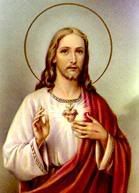
What a lovely month, the month of June! It is on June 15th that we celebrate the Feast of the Sacred Heart of Jesus. The image of the Sacred Heart is familiar to all Catholics and many traditional Catholic families have held or at least attended "enthronement" ceremonies. I would like to encourage all Catholic families to consider enthroning the most Sacred Heart of Jesus within their homes during the month of June.

"I will bless every house in which an image of My Heart shall be exposed and honored." This is the beautiful promise made by our Lord to St. Margaret Mary.

The idea of the Enthronement is that "in the Christian home a throne of love and veneration is erected for the Sacred Heart of Jesus, and that His sovereign rights over the family be thereby recognized." The practice is an external recognition of the fact that Christ is the real head of the home. It is not merely a passing act of consecration to the Sacred Heart but a permanent state of devotion and love. (taken from: Your Home, A Church in Miniature - Compiled by The Family Life Bureau in the early 1950s

Our family enthroned the Sacred Heart of Jesus in 1997. This year will mark the 10th anniversary of that enthronement. Anniversary celebrations can be observed by the entire family participating in a "reconsecration" as well as regularly offering consecration prayers. Here is a lovely prayer for the family:

Renewal of the Consecration of the Family

To be said at night prayers in union with all families in which the Sacred Heart has been enthroned.

Most Sweet Jesus, humbly kneeling at Your feet, we renew the consecration of our family to Your Divine Heart. Be You our King forever! In You we have full and entire confidence. May Your spirit penetrate our thoughts, our desires, our words, and our works. Bless our undertakings, share in our joys, in our trials and our labors. Grant us to know You better, to love You more, to serve You without faltering.

By the Immaculate Heart of Mary, Queen of Peace, set up Your kingdom in our country. Enter closely into the midst of our families and make them Yours through the solemn enthronement of Your Sacred Heart, so that soon one cry may resound from home to home: "May the triumphant Heart of Jesus be everywhere loved, blessed, and glorified forever!" Honor and glory to the Sacred Hearts of Jesus and Mary!

Sacred Heart of Jesus, protect our families.

Prayer Source: Our Christian Home by Rev. Joseph A. Fischer, Seraphic Press, Milwaukee, Wisconsin, 1954

For additional information regarding your own Enthronement, click on this link:
Catholic Culture.

Most Sacred Heart of Jesus, have mercy on us!
Read more!

Tuesday, May 29, 2007

Knit an elven cloak


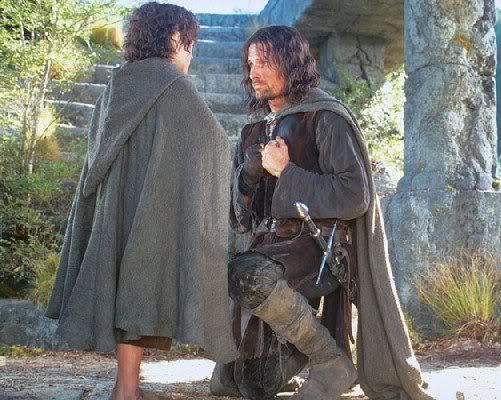
I am an avid knitter constantly searching for new and unusual patterns and fibers. Here is an interesting link for fans of the Lord of the Rings. Make your own elven cloak! Extremely cool, but also extremely pricey and rare fiber. Take a look at Stansborough Farms. Read more!
Morning or Afternoon?

Once again, it is a lovely morning. I sit alone at the computer, a gentle breeze rippling the curtains, while the birds sing their morning chorus. Would you wake your children up? The Wasson family has not yet finished school for the year. The search for a new home coupled with the monumental task of moving has left us with much to accomplish to round out the school year.

Every school day we face this dilemma: morning school or afternoon? The mornings are so enticing. It is so cool and inviting, the day simply begs to be "lived" right now! So, sometimes we do just that. We invite our friends over, share our day and then struggle to finish school work before supper. Other days, the morning just seems to be the best time to accomplish the task at hand...get it done and enjoy the rest of the day in freedom. Alas, mother is not helping when she enjoys the solitude so much...sigh...

It is a blessing to have these decisions! How many children are dragged from their beds and ushered off to a public institution for 7 hours a day? No prayer, no hugs, no quick run outside to check the garden...Thank you Lord, for all of the challenges of homeschooling. Mapping out the day, planning the curriculum, dealing with disciplinary issues and never getting enough laundry done. I am truly thankful that I have the privilege of agonizing over these and many other decisions
Read more!

Monday, May 28, 2007

Thank you!

What a blessing it is to be surrounded by such amazing friends. The past few days have been full of food, fun and conversation. Not much laundry done, I'm afraid to say, but there will always be laundry. These opportunities for fellowship amongst our "faith family" simply can't be missed.

Thanks to everyone for your attendance at the Wasson family "mega brunch". What an incredible way to celebrate Pentecost! The food was great, but the company was even better. We hope to host a barbecue soon...wait until you taste Roger's top secret sauce! We praise God for all of you and thank you once again for your part in building beautiful family memories.
Read more!

Saturday, May 26, 2007

Birthdays

Another birthday! Today Michael Gabriel Wasson is nine years old. Sunday we will host a brunch to celebrate the many joys of this month. It has been the goal of our family for many years now, to shift the focus on birthdays from the gift giving "extravaganza", to one of celebration. Don't get me wrong, here. My children have not yet attained sainthood and are just as excited over receiving gifts and cards as any other children. Nearly all of them are guilty of the "slash and shake" approach to birthday cards (you know...slash the card open, shake out the contents, pick up the cash)

We don't, as a rule, host "birthday" parties. We all like birthday parties, but in a large family it simply is not practical nor feasible. So, we host "celebrations" instead. Food, family, friends, fun. We try to encourage our children to look forward to the arrival of their friends and the fellowship which will bring true joy to the day. Any gifts received are set aside, to be opened later and thanks are offered beforehand.

Tomorrow is also the Feast of Pentecost, another birthday. "Veni Sancte Spiritus!" Happy Birthday to the One, Holy, Catholic and Apostolic Church...could there be a better reason to celebrate?
Read more!

Friday, May 25, 2007

Nil Desperandum

Nil desperandum! There is nothing to be despaired at! Unbelievable words during a time of extreme suffering or crisis. I am speaking first hand here. It is not likely that I will ever have to endure even a fraction of the agony that our Lord suffered on the cross. It is also highly unlikely that I will ever be burned at the stake, drawn and quartered or fed to the lions, tigers or bears. My sufferings have been so minuscule compared to the suffering of many of my friends. Nonetheless, there are days that I have begged the Lord for martyrdom!

Oh to be done with the strife and seize the crown of Heaven! Such presumption on my part, yet there are times that the tedium and day to day trials seem a far more harsh martyrdom than a few minutes in a fire. My day is a "fire" of another type, for the daily job of motherhood is a non-stop "dying to self". It is not the public, gloriously brave and edifying sight of courage in the face of death. It is the quiet, unobserved refining action of grace through small sacrifices. Climbing the mountain of laundry, reading the same book five times in a row, explaining quadratic equations and cleaning up yet another glass of spilled milk. Again...and again...and again. This is my glorious martyrdom and it is the one chosen by God to accomplish my sanctification.

There are times when my shoulders ache with the sheer amount of responsibility resting so precariously upon them. I worry that I will "drop the ball" or that I'm just not doing the job as well as I should. I have been in that place where the only prayer is the "...Spirit itself intercede(ing) with inexpressible groanings". That is when I pray through the pain and through the doubt. The answer is never in the pain, but on the other side of it.

So, nil desperandum! Everyday is better for the trials within it. Everyday, with God's grace, we shall be better for perservering.

Read more!

Thursday, May 24, 2007

Milestones


Today is my youngest daughter's 4th birthday. Sigh. The "baby" is not a baby any longer. This is the longest "space" Roger and I have had between children, a rather poignant reminder of how our lives are changing and how our roles are expanding. While still the parents of toddlers, we are also grandparents to three (soon to be four and one in heaven) beautiful grandchildren. For over twelve years we had at least one child, and frequently two, in diapers.

The last three pregnancies were hard beyond belief...bed rest from the sixth month on, not being able to walk, using a wheelchair and a walker and the distinct possibility of not being able to walk again. What a price...but what was purchased was beyond measure. Maximilian, Abigail and Rylee Elizabeth! I can't imagine a world without them, my family without them, ME without them. Though we would gladly welcome another child (please God!) into our family, we also know that our God has wisdom that supercedes our desire. May His will be done and may we remain open to His promptings.

So we celebrate the life of a child today, and in doing so, celebrate the lives of all children. God bless all families who remain open to grace, open to joy...open to life.


Read more!

Wednesday, May 23, 2007

Dona nobis pacem

"Pax Domini sit semper vobiscum!" These are the beautiful words pronounced at every holy Mass, no matter the language or culture. "The Peace of the Lord be always with you!" Our Lord walked among us. He lived, He loved, He laughed, He wept, He argued, He suffered and died. All that we might have salvation. That we might have peace. Always. How many things I allow to disturb that peace! I don't rest enough, pray enough, praise enough, thank enough...and then wonder at the disquiet within my soul. St. Peter and St. Martha...here I am. Boldly proclaiming my faith as St. Peter did, only to discover my weakness. "Anxious about many things" as St. Martha was, and frequently feeling that my efforts go unnoticed. Yet, here is the comfort...SAINT Peter and SAINT Martha. Their failings and the recognition of their weaknesses allowed our Lord His place in perfecting them. It was not through their efforts, but their cooperation with His actions in their lives. Catholics call this "grace". And His grace alone suffices for all things.

So, once again, I "fail forward towards success"...surrounded by the people I love most in this world and blessed beyond measure. Deo gratias!
Read more!

Tuesday, May 22, 2007

How a Catholic Nun Became a Grandmother

In 1992, the Wasson Family adopted its newest member, Sister Martha Conrad…but she is not Sr. Martha to us; she is simply Grandma Marty.

How does a Roman Catholic Nun become a grandmother of nine living children?
By God’s great mercy and through His infinite love.

Sr. Marty (as she is affectionately known) had been a religious sister for many years. I will not share her fascinating story at present, it alone would make for compelling reading. Instead, I will share with you a few of her thoughts regarding her vocation and the unbelievable way that our Lord gave her a most beautiful reward for her years of faithful service.
Sr. Marty received the call to enter religious life when she was very young, and though she always felt she would have many children, she never repined her decision to enter a life of poverty, chastity and obedience. For many years she faithfully served our Lord in many capacities : teaching in earlier years and heading a very large and effective outreach ministry in southeastern Kentucky for the last couple of decades. During all this time, Sr. Marty watched her many friends marry and have children. She participated with great love and fervor in the lives of her many nieces and nephews, as well. She observed the joys and sorrows associated with raising a family and still never regretted her vocation.

Years went by and Sr. Marty now observed a change. Her friends had shifted roles from parents to grandparents. As she observed the sheer joy in the lives of her “grand parenting” friends, her heart was stirred by a longing she had never felt before. In longing, she spoke out loud “Lord, I don’t have any grandchildren…I want grandchildren!” Sr. Marty has stated that she spoke these words without awareness…they just came out. There was a real confidence within her that our Lord could truly make this happen, yet she put it out of her mind.

One beautiful spring morning in 1992, a sweet seven year-old girl saw a lovely lady across the crowded school gym where we spent our fellowship time after Mass. Caitlin was drawn to the lovely lady and falling down on one knee while grasping both work-worn hands in her own she piped in her lovely, little voice: “You look like you would be a great grandmother…would you be my grandmother?” Sr. Marty was stunned! Had this precious child actually uttered these words? She had! Sr. Marty declared her emphatic “Yes!” with all her heart and asked Caitlin to point out her parents.

A few days later, a very surprised mother receives a call from this sweet soul. I was not the least surprised that Caitlin had done this, her heart was so full of love and affection. From that point on Grandma Marty has been a part of our family. I can’t imagine not having her and it seems as if she has always been here. Baptism, Confirmation, First Holy Communion…you name the sacrament; she has been there! Christmas, Easter, St. Valentine’s Day, birthdays…name the holiday; we’ve shared it with her in so many joyful ways.

Grandma Marty will tell you that our family has been the most perfect answer to her prayer, but, the truth is…she is the answer to OUR prayer. A prayer we had not yet uttered and yet God in His infinite wisdom answered in the most incredible way possible.
We have moved to another state and Grandma Marty is still in Kentucky. We miss the impromptu visits, breakfast after Mass, coloring Easter eggs and just the simple knowledge that she was so close by. God be praised for His wisdom in putting us together as “family”.

A nun who had never married or had children became a grandmother…”with God all things are possible.”


Read more!

The Tooth Fairy

Abigail, age five, has lost two teeth within the last 48 hours. There are so many simple joys in parenting - namely, all of the firsts: the first word, first step, first birthday, first day of school, and the loss of the first tooth.

As the mother of many children, it amazes me how alike each of the children are in their responses to these "firsts". Excitement, then timidity; courage, then fear; trust and finally surprised elation! In the loss of the first tooth, all of these emotions are stamped indelibly upon the upturned face of that trusting, yet fearful child. Fearful, yet still hopeful...trusting in the best possible outcome. Lord, may I learn this same lesson!

So now we come to the dilemma that every parent faces...tooth fairy or no tooth fairy? Having lived on both sides of this question, I say "no tooth fairy". I lived under the tyrannical reign of that tiny imp for many years...she is a harsh taskmaster. Promises of cash in exchange for a tooth. How many times was said tooth carefully wrapped and tucked under the pillow, only to be forgotten by her royal highness? Too many times to count. Though many teeny, tiny letters were written, offering apologies, the Wasson family finally fired her. Mom and dad now offer cash for teeth and simply mail them in bulk to the New Tooth Facility, where they will be ground into a fine powder and sprinkled into the mouths of sleeping babes to promote the growth of new teeth. A tidy solution to a troublesome problem!
Read more!

Monday, May 21, 2007

Good Morning!

It is a lovely, though somewhat cool morning. I've been up since sunrise...breakfast and lunch packed for Roger and a few moments of silence before the children awaken. It is always such a dilemma - what to do with this time?

Prayer should be the first order of the day, though sometimes I must admit that the laundry receives my first attentions. Still, the opportunity to recollect oneself and approach the Throne of Heaven, should never be missed.

Uninterrupted computer time is at a premium, as well. A teenage daughter with a burgeoning photography career (she is quite good) as well as her own "web world", sons obsessed with computer gaming and a 5 year old who has just discovered EWTN for kids...sigh...

So, I check my mail, make my post, look at the news and weather...let the games begin! School today, laundry this afternoon...and a million and one smiles, tears, distractions and the occasional disaster. Thank you, my God , for my life... Read more!

We shall see...

News regarding the long awaited Motu Proprio continues to circulate. A statement issued by Cardinal Castrillon last week after his meeting with the Holy Father seems to confirm rumors. Here is a portion:

"There is no turning back, [the Pope] is not leading the Church to a reverse position; the Pope is the Vicar of Christ and has the Holy Spirit who always guides him forward, which does not mean that things which may have deteriorated may not be perfected."

"It [The Traditional Mass] will not be imposed on anyone, it does not in any way contradict the current [Mass], the Mass of the Council Fathers was that of Saint Pius V, they did not celebrate the Mass of Paul VI, these two Masses are not be be [mutually] opposed." "In the Mass of Saint Pius V there is a ritual expression which is enjoyed by some; there are those who wish to celebrate it occasionally, but without it meaning any disregard, [but] complete respect for the new rite."

"The Pope wishes to preserve for mankind a treasure which sanctified the Church for more than a thousand years: the rite codified by Saint Pius V; this treasure, this cultural expression, this language which was the language of the Church from the earliest time". [Benedict XVI] "loves the liturgy [and] does not wish to retro act, does not intend to impose, it is an offer for those who have this sensibility."


A dear friend of our family has also received confirmation from Dr. Alice Von Hildebrand that the Holy Father did indeed reveal to her that the Motu Proprio would be released in May.
Read more!